
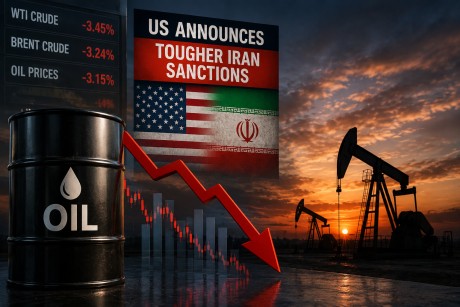
On Tuesday, oil prices fell more than 3%, hitting their lowest level in a week as investors weighed the implications of new U.S. sanctions against Iran. The global benchmark, Brent crude, decreased by 3.1% to $89.31 per barrel, while West Texas Intermediate (WTI) saw a 3.34% drop, settling at $82.17. This decline followed a week of strong increases for both benchmarks, with Brent surging 6.6% and WTI climbing 5.7%.
The United States has intensified its sanctions on entities and nations engaged in economic dealings with Iran. These measures aim to exert greater pressure on Tehran and undermine its economy amidst ongoing tensions. As a strategic point, the Strait of Hormuz remains a focal area of concern for oil markets, given its significance as a major global energy passageway. Iranian authorities have cautioned that oil shipments through this vital channel could be obstructed if Washington continues to escalate its pressure.
Adding to the complexities, shipping hazards have risen, highlighted by a report of a tanker being hit near Oman’s Musandam peninsula. Moreover, persistent assaults in the Red Sea have further contributed to the ambiguity surrounding global energy supply stability. Despite these geopolitical challenges, oil prices experienced a decline as traders concentrated on evaluating the potential impact of the newly imposed sanctions and whether they could substantially influence Iran’s oil exports.
While the market remains alert to the developments in the Strait of Hormuz and the broader Middle Eastern region, the immediate focus is on the sanctions’ ramifications. Analysts are closely monitoring how these economic restrictions might disrupt Iran’s oil trade and the subsequent effects on international energy markets. These unfolding events underscore the delicate balance between geopolitical tensions and economic policies shaping the global oil landscape.